Metrics.
What are they, medically speaking?
Usually numbers. For diabetics of all stripes, it's usually blood glucose level numbers, HbA1c, time in range, ketones, the presence of dawn phenomenon, numbers of and severity of hypos, etc.
These are objective and immutable. Your GAD antibody test numbers determine whether or not your body is destroying the your insulin-producing beta cells. Your c-peptide test shows how much insulin (if any) your body is producing.
These are the metrics used to determine eligibility for certain tech available to type 1 diabetics in a lot of places.
What's missing? The squishier things. Mainly quality of life.
And here's why that's probably the most important thing and my confusion as to why it is constantly left out.
Chronic conditions are chronic.
I know, fuck me, right?!
If you've got some nasty but tolerable side effects from a 14 day treatment, you can usually just roll with it because hey, it'll be over in two weeks.
There is no 'over' for us, except for death. (Some would argue those who get dual transplants, usually kidney and pancreas have an 'over' but they're just swapping the pain in the ass of T1D for the pain in the ass of being a transplant recipient.)
Story time!
When I was newly diagnosed, I was told that I would be able to lead a 'normal' life. That's a lie. I can lead a facsimile of a normal life but it requires constant attention. Sometimes it's high level attention, sometimes it's low level attention, but having T1D means that there's a part of your brain that is constantly on T1D duty.
Upon realising that this was my 'new normal', I started looking at what was out there. I found Libre, I found Dexcom, I found a variety of pumps.
Wait. I can have a bit of tech attached to me that lets me be 4-hours-notice spontaneous rather than 24(+)-hours-notice spontaneous? SIGN ME UP.
So I asked my endocrinologist consultant "How do we make this happen?"
'Go to DAFNE,' they said. I went to DAFNE.
"Okay, how do we make this happen?"
'We'll discuss it at your next appointment,' they said. That next appointment that was supposed to be six months on but was pushed to eight months because of consultant illness, holidays, etc.
"Okay, how do we make this happen?"
'Looking over your information, you seem like a good candidate. We'll discuss it at the next pump assessment clinic. They happen every two weeks.'
"Great! Let me know when I need to come in."
Three months later...
'Your A1c is good and we're not seeing any indication of dawn phenomenon [note: their meter reader wasn't working so they had none of my meter data], so... Are you planning on getting pregnant? No. Sorry, we can't recommend the pump for you.'
I went home and cried.
I worked so hard in order to qualify. I put aside the time to do the soonest DAFNE course they had spaces in. I worked hard to reduce my A1c. I worked hard to be a 'good' diabetic.
And I honestly felt like the thing that was my biggest concern - burnout - wasn't being taken seriously. Because it's psychological. Because they've had people who hated the pump (which impacts me because I'm the same as those people?). Because my quality of life with a chronic condition doesn't matter.
I am stuck with this until I die. (And please, no articles on the latest 'cure trials' - it turns into 1984 where 'The cure is ten years away. The cure has always been ten years away.')
I am stuck with a chronic autoimmune condition that affects every aspect of my life until I die.
My relationship with food. With exercise. With my husband. With my family of origin. With sleep. With work...
There is no part of my life that isn't touched by being type 1.
And yet, because there is no easy way to turn it into a number, my quality of life gets little to no consideration.
Because I'm 'well managed'. Because I'm 'compliant'. Because I'm not in a 'crisis situation'.
Why does it have to turn into a situation where I am actively in harm's way in order to be considered for a device that will make my quality of life better?
Just because there is treatment for this chronic condition doesn't make it any less chronic. It doesn't make the psychological strain disappear. Quality of life needs to be seen as important to the consultants as the more easily measured metrics.
When you tell me my quality of life doesn't matter, what I hear is that the only thing you care about is my longevity, not who I am as a person.
[Addendum, 05 Jul 18: I do not fault the consultants entirely. They are going based on the edicts given to them by NICE in the UK and insurance companies elsewhere. Where I fault the consultants is their lack of transparency and the number of times I've been told 'you're a good candidate' and then followed by a no because I haven't met some unknown criteria. The obfuscation on the clinical side makes this chronic condition even more frustrating than the baseline.
I fully understand that the vast majority of Diabetic Health Care Professionals wants the best for their patients and they're hamstrung by various entities. Tell me. I will share your frustration and be more understanding than if I get the runaround.]
Showing posts with label 2018. Show all posts
Showing posts with label 2018. Show all posts
Wednesday, 4 July 2018

Monday, 11 June 2018
Diabetes Week 2018
This week is Diabetes Week in the UK. It's 2018. There is no cure for Type 1.
Okay, now that we've gotten the absolutes out of the way, let's go for the subjective.
Books! There are books out there. Some are good, some are adequate, some are a matter of opinion. I'm not going to slag any book off, but I will share some of the books that I think should be in every person with T1D's library.
We are ultimately in charge of the vast majority of our own care.
 Think Like a Pancreas by Gary Scheiner
If you've been recently diagnosed, this book tells you everything that your endocrinologist and specialist nurse didn't have time to cover in your appointment. You walk out, your head swimming with information and (if you had the wherewithal to remember to do so) hastily scribbled notes that make no sense to you right now.
This book explains so much of what you need to know about how insulin works, what it does, what it doesn't do, and how to interpret the data that now seems to rule your life.
The best part about this book is the accessibility. If you are recently diagnosed, there will be things in here that make no sense - yet. But the information that you can take away even at the start will help you in your diabetic management. Once you've got a few months or a year under your belt, go back for a re-read. That stuff that didn't make sense is all of a sudden applicable to your life.
I read this at least once a year. I'm about due for a re-read.
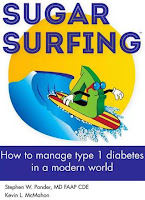 Sugar Surfing by Stephen W. Ponder
I'm going to preface this by saying two things:
Sugar Surfing by Stephen W. Ponder
I'm going to preface this by saying two things:
1. This book relies heavily on the use of a Continuous Glucose Monitor or Flash Glucose Monitor.
2. It's a bit repetitive.
Even with those two things, I suggest it. Why? A lot of times, when we PWD are given or self-fund a CGM, we're excited! More information! Data points! Fewer finger pricks! All of these are good things... But what happens when you look at that data and think 'okay, now what?'
This book helps you with the 'now what' question. What is it that your Dexcom or Medtronic or Libre is telling you? How do you put that data to practical use?
We're told 'pre-bolus, except when eating out because sometimes food takes a long time to come to the table or it's more than you expected, or...' But then comes the questions... How far in advance? Do I pre-bolus differently for different foods? What about my carb ratios?
Like so much in the life of a PWD, there's not a one-size-fits-all answer. (Aside from take your insulin and carry hypo treatments. Those two are always.) What Sugar Surfing does is give you more tools for your T1D toolkit on how to utilise that data to best manage your T1D.
 Diabetes and Wellbeing by Jen Nash
This is not a 'read it and you're cured!' book. And if any book dealing with T1D and the emotional strain therein tells you that it's going to, save your money.
This book is based off of CBT (Cognitive Behavioural Therapy) techniques in order for you to enlarge your toolbox (I use this term a lot. I was in therapy. It works for me.) in order to cope and engage in the self-care that is necessary when dealing with the wearing nature of a chronic condition.
One of the things that CBT covers is 'mindfulness'. It's a way of checking in with yourself and figuring out what it is that you can do things about. And then moving into action and resolution if possible.
We all know those relentlessly positive PWD. They've got it all dialed in, a perfect A1C, and nothing causes a blip. Or so they tell us on social media. And for some people, that's what it is. For the vast majority of PWD, there are more ups and downs than an overcorrected hypo. Having the tools to cope with the stressors that go hand in hand with this condition is helpful and can prevent or delay burnout.
If you only have the time/money/inclination to buy one, get Think Like a Pancreas.
Do you have any 'must have' books associated with T1D? Let me know in the comments!
Okay, now that we've gotten the absolutes out of the way, let's go for the subjective.
Books! There are books out there. Some are good, some are adequate, some are a matter of opinion. I'm not going to slag any book off, but I will share some of the books that I think should be in every person with T1D's library.
We are ultimately in charge of the vast majority of our own care.
Think Like a Pancreas by Gary ScheinerIf you've been recently diagnosed, this book tells you everything that your endocrinologist and specialist nurse didn't have time to cover in your appointment. You walk out, your head swimming with information and (if you had the wherewithal to remember to do so) hastily scribbled notes that make no sense to you right now.
This book explains so much of what you need to know about how insulin works, what it does, what it doesn't do, and how to interpret the data that now seems to rule your life.
The best part about this book is the accessibility. If you are recently diagnosed, there will be things in here that make no sense - yet. But the information that you can take away even at the start will help you in your diabetic management. Once you've got a few months or a year under your belt, go back for a re-read. That stuff that didn't make sense is all of a sudden applicable to your life.
I read this at least once a year. I'm about due for a re-read.
 Sugar Surfing by Stephen W. Ponder
1. This book relies heavily on the use of a Continuous Glucose Monitor or Flash Glucose Monitor.
2. It's a bit repetitive.
Even with those two things, I suggest it. Why? A lot of times, when we PWD are given or self-fund a CGM, we're excited! More information! Data points! Fewer finger pricks! All of these are good things... But what happens when you look at that data and think 'okay, now what?'
This book helps you with the 'now what' question. What is it that your Dexcom or Medtronic or Libre is telling you? How do you put that data to practical use?
We're told 'pre-bolus, except when eating out because sometimes food takes a long time to come to the table or it's more than you expected, or...' But then comes the questions... How far in advance? Do I pre-bolus differently for different foods? What about my carb ratios?
Like so much in the life of a PWD, there's not a one-size-fits-all answer. (Aside from take your insulin and carry hypo treatments. Those two are always.) What Sugar Surfing does is give you more tools for your T1D toolkit on how to utilise that data to best manage your T1D.
 Diabetes and Wellbeing by Jen Nash
This is not a 'read it and you're cured!' book. And if any book dealing with T1D and the emotional strain therein tells you that it's going to, save your money.
This book is based off of CBT (Cognitive Behavioural Therapy) techniques in order for you to enlarge your toolbox (I use this term a lot. I was in therapy. It works for me.) in order to cope and engage in the self-care that is necessary when dealing with the wearing nature of a chronic condition.
One of the things that CBT covers is 'mindfulness'. It's a way of checking in with yourself and figuring out what it is that you can do things about. And then moving into action and resolution if possible.
We all know those relentlessly positive PWD. They've got it all dialed in, a perfect A1C, and nothing causes a blip. Or so they tell us on social media. And for some people, that's what it is. For the vast majority of PWD, there are more ups and downs than an overcorrected hypo. Having the tools to cope with the stressors that go hand in hand with this condition is helpful and can prevent or delay burnout.
If you only have the time/money/inclination to buy one, get Think Like a Pancreas.
Do you have any 'must have' books associated with T1D? Let me know in the comments!
Subscribe to:
Posts (Atom)
Yet Another Origin Story
I figure I should introduce myself. I'm Ryn, and I'm a person with diabetes. I was diagnosed in January of 2016 after being admi...

-
I switched from Insulatard (an intermediate insulin) to Toujeo recently. This was after having been on Lantus and being taken off (site re...
-
 (That's a reference to a P.M. Dawn song, for the young'uns.) Dawn Phenomenon. It sounds innocuous, doesn't it? Dawn... That time...
 -
 This week is Diabetes Week in the UK. It's 2018. There is no cure for Type 1. Okay, now that we've gotten the absolutes out of the...